Friday, 6 October 2017

These Are The Fastest Growing Programming Languages

A lot of new programming languages are making their way to the top and JavaScript is holding the top position for the past few years. Seems like the situation is about to change and JavaScript may soon be dethroned by Python. Python is one of the fastest growing languages and by 2019, it would have a clear domination in the programming community.
This is a prediction made by StackOverflow, a programming Q&A centre. With more than 50 million amateur and professional developers visiting the website, StackOverflow is one of the qualified companies to make such a survey. Based on the huge increase in the questions from developers on Python and the data they have collected, StackOverflow made this survey possible.
Stack Overflow data scientist David Robinson said in a blog post that, “The term ‘fastest-growing’ can be really hard to define precisely, but we make the case that Python has a solid claim to become the fastest-growing major programming language.


progeamming languages growth
Just in the past five years, Python went from least to top six most popular programming languages with a whopping 2.5x increase in the questions and views on the language. StackOverflow also stated that these statistics are related to developers from countries with “high-income”  and represent the trend in the United States, United Kingdom, Canada, Germany and other such countries.
The secret behind the growth of Python is its flexibility and versatility. Python is generally used by web and desktop developers, devops/sysadmin and recently even data scientists and machine-learning with Python became popular.
“It seems like Python is used in every domain — system operations, web development, deployment, scientific modeling, etc etc. There is no other language that is so versatile,” says Jacqueline Kazil, board director of the Python Software Foundation (PSF).

What are the Latest Technologies for Drivers?

While self-driving cars are the most anticipated auto technology, it is quite unlikely that you will find one on the road within the next year or two. In the meantime, many new technologies have been developed to take driving to a whole new level. Some of them are already in use, while others will be available in the near future. Here is a look at the latest innovations in driving technology.

Latest Technologies for Drivers

Adaptive Headlights for Seeing Around Corners
Being able to see around a corner before turning can certainly reduce your chances of getting into an accident. This is possible if your vehicle is equipped with adaptive headlights. These headlights use a camera or GPS data to determine whether the road is curving, and they will automatically brighten or dim depending on the situation. At night, they will switch to low beams if they detect an approaching vehicle. According to the AAA Foundation for Traffic Safety, adaptive headlights are theoretically relevant to about 90 percent of the accidents that happen at curves during nighttime.

Integrated Camera and Radar
Vehicle-mounted cameras are nothing new, but now, they can be integrated with radar to scan a certain distance ahead and warn you of a possible collision. This system is installed on the rear-view mirror, and it can help prevent accidents by communicating with other adaptive systems in your vehicles, such as pedestrian detection and autonomous braking.
Touchless Gesture Control
An innovation called Touchless Gesture Control is now being used to replace the switches and buttons of a vehicle’s interface, enabling you to open a window, adjust the air-conditioner, and change the audio with a swipe of your hand. It will activate a system when its proximity-aware sensors detect the presence of your hand near a device.
Voice Control
If you find that waving your hand is too inconvenient or risky while driving, you can opt for a voice control system instead. Just by giving a verbal command, you can control the temperature, audio, or navigation system in your vehicle, as well as your cell phone. The system is able to recognize preset voice commands, and it can be easily switched on and off by pressing a button.
Loading and Dispatching App
Many truckers find the traditional method of planning dispatches and loading goods troublesome and inefficient. It involves long phone conversations with brokers, booking round trip loads, and using poorly-designed platforms that require you to click on too many queries. Three trucking experts, namely, Bill Busbice, Harry Hover, and Paul Svindland, developed the HWY Pro app to enable truckers to perform all these tasks and deliver a full haul within six taps on a smartphone. It also allows users to plan deliveries of thousands of loads with minimal time and effort.
The above-mentioned technologies can be useful to both ordinary and professional drivers. They can reduce your accident risk and make driving a more pleasant experience.

Java 9 is Finally Released, New features and Improvements

JAVA 9 Features

Java 9 has been finally released. The programming enthusiasts would be pretty relieved as Java 9 Standard Edition was previously delayed due to modularity controversy. If you are seeking for Java SE Development Kit 9 you may visit the link below:
http://www.oracle.com/technetwork/java/javase/downloads/index.html

Java 9 features: Brief overview

Project Jigsaw – Module System


So, how is this different from the last version of Java SE 8? The most effective change in Java SE 9 is the change in the form of Project Jigsaw, which is the new module system. It’s the most important feature of java, which has been criticized a lot. This feature brings modularity to JDK, runtime images, Java source code etc. In the world of Java OSGi, JARs are considered as the unit of modularity. By the way, developers can make their own modules and simplify the code
The primary goals of this project were to:
  • Make it easier for developers to construct and maintain libraries and large applications;
  • Improve the security and maintainability to Java SE Platform
    Implementations in general, and the JDK in particular;
  • Enable improved application performance, and lastly
  • Enable the Java SE Platform, and the JDK, to scales down for use in small computing cloud and dense cloud employments
JShell
With JDK 9, now one can fire JShell from the console and go crazy with their Java code. JShell allows you to test different Java constructs without any hassle. Jshell introduces a REPL(Read-Eval-Print-Loop) environment in java when Java 9 is released. With this new style of writing Java code, you can write and test small snippets of code quickly and easily. JShell will compile and run the code there and then.
Stream API enhancements
With Stream API enhancements, Java 9 comes with added methods to conditionally take or drop items from the Stream, create a Stream from nullable value while expanding Java SE APIs, etc.
Process API Changes
With Process API improvements, Java 9 ensures that OS process is controlled and managed in a better manner. For instance, The Runtime.getRuntime().exec() API was the only way to spawn a new process before Java 5. After which ProcessBuilder API was introduced which was better for spawning a new process.
In Java SE 9 we can now obtain a lot of information about the process via the API java.lang.ProcessHandle.Info API:
  • The commands used to start the process
  • The arguments of the command
  • Time instant when the process was started
  • Total time spent on it and user who created it
Segmented Code Cache
With the help of Segmented Code Cache in JDK 9, the code cache can be divided into different segments. Each of those segments contains compiled the code of particular type. This Java 9 feature is expected to improve performance.
Instead of a single area, the code cache will be segmented into 3 by the code’s lifetime in cache:
  • Code that will stay in cache forever
  • Short lifetime
  • Potentially long lifetime
Due to these segmentations, several performance improvements occur. E.g. the method sweeper would be able to skip non-method code and act faster.
Ahead of Time Compilation
While it’s in the experimental stage, AOT- compilation is expected to improve the start-up time of applications.
New HTTP 2 Client
Java 9 features list is incomplete without the mention of new HTTP/2 and WebSocket. It’ll improve web page loading times, performance, and reduce resource usage.
Parser API for Nashorn
JDK 9 ships with parser API for Nashorn, whose goal was to implement a lightweight high-performance JS runtime in Java with native JVM. This API ensures better Project Nashorn JS support.
Other major- minor features
The other Java 9 features are:
  • Multi- release JARs
  • Process API updates
  • Garbage Collector improvements
  • Better Javadoc
  • Private interface methods
That’s not all; you can find more by the following link:
http://www.oracle.com/technetwork/java/javase/documentation/9u-relnotes-3704429.html

Here are 5 secret settings in Windows 10 you can unlock

Windows is a great operating system which gives everything a user needs with a good interface while allowing them a little bit of customization. A lot of settings in Windows are hidden from users so as to prevent them from unknowingly messing with settings. But, if you know what you are doing, you can make a few tweaks. Here are some examples:
If you want to make any changes to the registry, type “regedit” in the search box provided in your taskbar and then launch the highlighted application. It is very important to note that you should follow the tutorial at your own risk. While you are not supposed to make changes to the registry as it could cause a serious problem, it is very fun to play around.
1. Switch to dark theme


Windows 10 allows you to choose a dark theme. To get this, navigate to HKEY_LOCAL_MACHINE\ SOFTWARE\ Microsoft\ Windows\ CurrentVersion\ Themes and then create a Personalized key. Now create a new DWORD value inside this named AppsUseLightTheme and leave the value as default which is 0.
Repeat this process for the HKEY_CURRENT_USER \ SOFTWARE \ Microsoft \ Windows \ CurrentVersion \ Themes and now when you restart your PC, the new theme appears. Delete the two AppsUseLightTheme DWORD values to go back to the light theme.
To get back to the old theme, delete the two AppsUseLightTheme DWORD values to go back to the light theme.

2. Increase the Transparency of taskbar

Using the general Personalization settings, you can make the taskbar transparent. But, if you want to make it more transparent then here is a registry tweak for you.
The registry key needed is HKEY_LOCAL_MACHINE\ SOFTWARE\ Microsoft\ Windows\ CurrentVersion\ Explorer\ Advanced (note Regedit does have a Find function). Now make a UseOLEDTaskbarTransparency DWORD value inside it, and then set it to 1. If you wish to undo the changes, just remove the same DWORD value.

3. Increase startup speed

Whenever you start your Windows OS, it puts a delay to any apps that boot with Windows. If you want, you can disable this. This setting is especially useful if you do not have many apps which start along with Windows boot up.
For this, go to HKEY_CURRENT_USER\ Software\ Microsoft\ Windows\ CurrentVersion\ Explorer\ Serialize, now create a new DWORD value named StartupDelayInMSec and set it to 0. If you want to go back, delete the Serialize key.

4. Hide OneDrive from File Explorer

If you do not like OneDrive to be in your navigation panel, you can easily remove it using this registry tweak. The registry key to open is HKEY_CLASSES_ROOT\ CLSID\ {018D5C66-4533-4307-9B53-224DE2ED1FE6}.
 Find the System.IsPinnedToNameSpaceTree and double-click on it, and then set its value to 0. Doing this hides the OneDrive icon from your navigation pane but it is still there on your system—go to C:\ Users\ <username>\ OneDrive if you need to find it again.

5. Disable the login image

Whenever you turn on your device, you’ll see a default image created by Microsoft in your login screen, but you can easily disable this.  Go to HKEY_LOCAL_MACHINE\ SOFTWARE\ Policies\ Microsoft\ Windows\ System and then create a new DWORD value.
Call this value DisableLogonBackgroundImage and then set its value to 1. The same solid colour you have set for the accents elsewhere in Windows will be set on the login screen too. You can read this great  read  guide from geeks for geeks to know more.
If you like this article, take time and share your thoughts.

ARM and The Operating System for Internet of Things

Most programmers will be familiar with Windows, Linux, Android and Apple’s iOS. None of them are new, none of them lend themselves to the technology that is going to represent 90% of the lines of code in the next decade. The IoT (Internet of Things) is being led by ARM whose processors are powering in >95% of mobile phones.
The key feature to their success is their exceptionally low energy demands. They have proven themselves time and again. They resisted bloating the silicon with Thumb and Jazelle – both use a lookup table. So, every instruction is actually executed as a 32 bit (and now 64 bit) ARM instruction within the processor. More recently they have added onboard GPUs aimed at the lower end handsets. But as always, low-power has been the chief aim.
All of the lessons learned from the handset (and SIM) designs either by them or by others who have obtained licenses.  It gives them the confidence to write an OS for systems that cost cents rather than dollars per unit. They are already part of the team behind the BBC Micro. It is a pico computer with a 16MHz ARM Cortex M0+ with 16 Kbytes of RAM and 256 Kbytes of ROM. Every school child in the UK is given one of these tiny machines in their first year in secondary education.


The Operating System for Internet of Things

Considering ARM’s history of long-term investment, teaching a generation to learn their new Mbed Operating System which is currently in its 5.5 release IS long-term but is giving notice to the world. This is a new departure for ARM and happily, they have avoided the pitfalls of closed development. I’m sure many readers can attest that being an independent developer normally entitles you to ZERO technical support. Not so with MBed. Free to join the community and a console-like (from my experience) technical support. The people who support you are the people writing the OS!
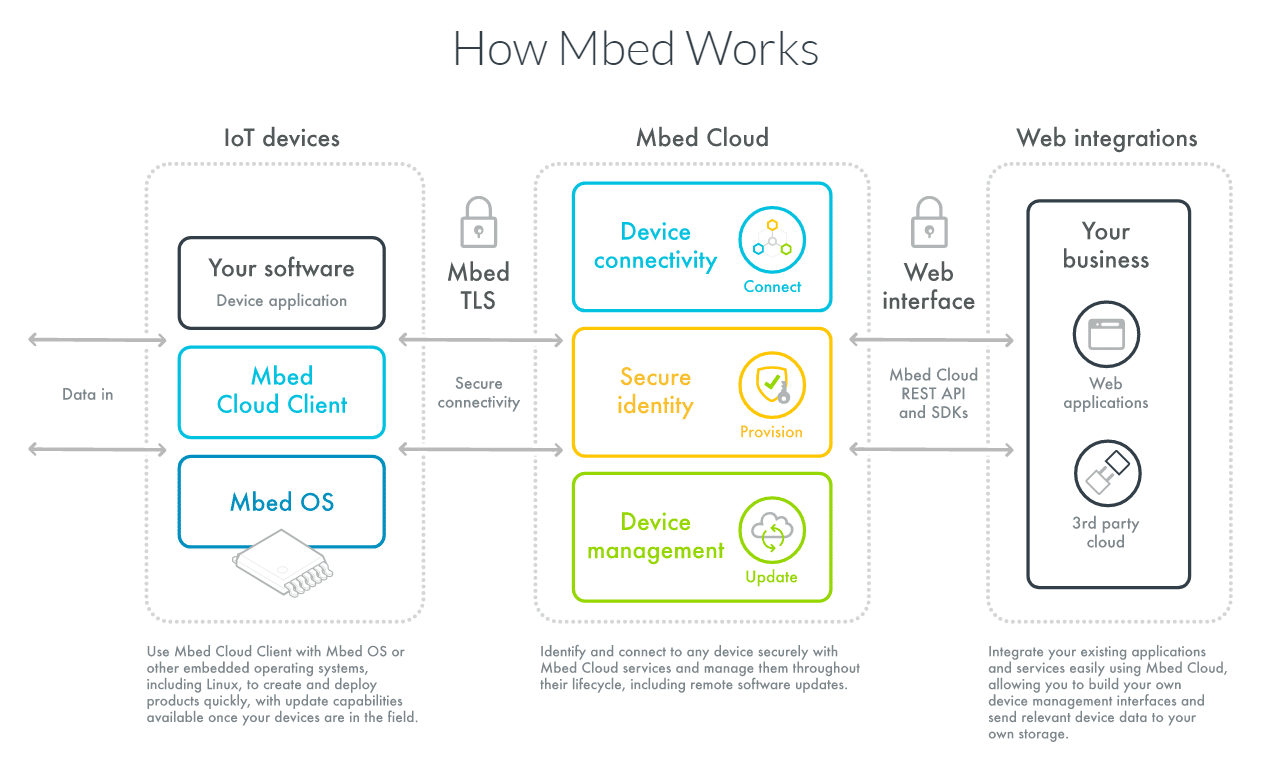
ARM - Mbed OS for IoT
Working with the MBED OS . Credit: mbed.com
So like every new OS, seeing its development cycles tell us quite a lot about their thinking. At first glance, it reminded me of the Nintendo 64’s OS. Both pre-emptive and program-mediated multitasking and multithreading are available and the CPU ‘sleeps’ when no processing is required. The difference is that it’s the all-important power consumption that is important. Many of the fields describing a process are to manage power. You can even compile code on-line making bug-finding that little bit simpler.
Clearly, C++ is the language it was designed for but Python and other languages are becoming available. Github is where the code is shared and the volume of traffic is increasing rapidly. Certainly there are other IoT Operating System options but as far as I know, it’s the only option that means that your code ends up used by all. I’m developing a speech codec so incorporating code into the OS ensures that everyone can play with the functionality and decide if it becomes a standard.

Here are several examples of practical IoS application:

1) Real-time control of home electronics with feedback.

This covers everything from ‘waking’ your home when you are expected home but able to use your proximity (automatically) via your phone through physical proximity of manual changes via any capable internet service. Now think about heating, lighting, cooking, air-conditioning, washing machine, tumble-drier, and dishwasher… just for a start. Presuming you have Wi-Fi within your home, it will all be free. Your refrigerator will suggest meals from food about to pass its use-by date, your washing machine and dryer will analyze how dry and how soft your clothing is and recommend a conditioner and when your oven needs cleaning, there is sure to be a ‘preferred’ cleaning product. That is the ‘value added’ aspect of the IoT.

2) Stock management, control, and analysis.

While large concerns currently use bar-codes and increasingly QR codes, soon printed silicon will provide every physical object with a unique CPU that draws its power from local Wi-Fi signals. An item can be traced back to the individual workers who made the item to payment and onwards to sales, shrinkage, and support. An item knows when it is being stolen, acts as a receipt to the buyer and item data for items returned due to malfunction all sit on a single system. That is the ‘price value’ aspect of the IoT.

3) Physical, data & currency security.

We are seeing an increase in the pieces of data we require to hold which rely on inherited security. From electronic locks to ID to Bitcoin hashes to paper money. The user is always at the bottom of the security chain. With variegated forms of security, inherent costs rise. The single most common form of unique ID in the world is the SIM card. Anybody who has played with one of these knows that AVR and ARM have almost 100% of the market. There is no surprise that ARM is becoming more and more common. When you know what a SIM can do, it can be annoying that you only have such minimal control of an item that you bought.
Now consider security with each of YOU being at the top of a given chain. You can give someone a key giving them limited access to your car, your office or your home? While a physical key can be copied, we have robust digital security that can be tailored to give someone a subset of your data. Rather than needing an external system to verify a digital transaction, distributed security is less liable to hacking. Payment via digital currency is already seen with loyalty cards in chain stores and by credit/debit cards and a stolen banknote can be traced. While governments like central control, citizens can feel empowered that they control security. This vision has both price-value and ‘perceived value’.
I’ve avoided doing it to a great deal of technical data, those ready to code would do well to read https://docs.mbed.com/docs/mbed-os-handbook/en/latest/ and I will posts some nice snippets of both C++ and assembly-language code because it is my opinion that the ARM core will prevail and if you can provide the customers functionality requirements on a ¢67 chip while other developers need a ¢81 chip, that is a saving of $120000 if 1 million chips are made. This is where the skills and experiences of hackers will pay off. I’m using ‘The Definitive Guide to the ARM Cortex-M0’ book (I still like paper) but Everything in the book is free here https://developer.arm.com/products/processors/cortex-m/cortex-m0-plus

This Company is ready to pay you $500,000 if you can hack WhatsApp

A company named Zerodium has recently announced that they are ready to pay you $500,000 if you can find an exploit in WhatsApp and Signal, two popular messaging apps with hundreds of millions of users across the world. A huge prize money like that is irresistible for hackers.
To avail the prize money, you have to find remote code execution and local privilege escalation vulnerabilities in these two applications. A huge offer like this may actually damage the trust users have towards these messaging platforms, but actually, the firm is not into making tools to attack the users.

What’s in it for them?

This firm, rather than attacking the users with the flaws they found, they sell these zero day bugs to various organizations and governments, even though they do not inform whom they sell the information to.


The major customers of ZERODIUM are huge corporations in defense, technology, and finance. They also sell the zero day information to government organizations when they need specific cyber security capabilities.

Win $1.5 million by hacking an iPhone

Apart from the latest WhatsApp exploit, Zerodium is offering other huge changes like winning $1,5 million by hacking an iPhone. It is not yet clear if someone ever discovered such an exploit and sold it to the company.
“ZERODIUM pays premium bounties and rewards to security researchers to acquire their original and previously unreported zero-day research affecting major operating systems, software, and devices. The majority of existing bug bounty programs accept almost any kind of vulnerabilities and [proof of concepts]but pay very low rewards, at ZERODIUM we focus on high-risk vulnerabilities with fully functional exploits, and we pay the highest rewards on the market,” the website adds.

Why Python Programming Language is very useful for Hackers?

Programming is one of the most important skills of a hacker. When someone wants to become a hacker, he/she has to be a good programmer. But, what is the best programming language for hackers to begin with? Although, It is very important to have basic knowledge of every programming language still you have to master in a particular language. For that purpose, Python is the most popular programming language among hackers.

Why is Python Programming Language very useful for Hackers?

When you start learning the core of hacking, Python is great. With a giant standard library and a packaging system that puts prebuilt tools and frameworks at your fingertips, it is often very easy to hack something into existence.


1. Python is an Object-Oriented programming

Object oriented programming approach is the most popular approach for software development. It uses classes and objects to create models based on the real world environment. Object-oriented Programming makes it easy to maintain and modify existing code as new objects are created inheriting characteristics from existing ones. This cuts down the development time considerably and makes adjusting the program much simpler.

2. Python has a Simple Structure

Python programs take much less time to develop. Its programs are typically 3-5 times shorter than equivalent Java programs. This difference can be attributed to Python’s built-in high-level data types and its dynamic typing. For example, a Python programmer wastes no time declaring the types of arguments or variables. It supports a programming style that uses simple functions and variables without engaging in class definitions. Python programs follow simple English-like structure.
Python programmer can finish in two months what two C++ programmers can’t complete in a year.
Simple Hello world program in Python:
print “Hello World!”
Simple Hello World program in Java:
public class HelloWorld {
public static void main(String[] args) {
System.out.println(“Hello, World”);
}
}

3. Python is a strong scripting language

Python is a general-purpose programming language as well as a scripting language. It can be used for everything that is done in Java. Python and Java interpret during runtime. It allows a good developer to play with hardware as well like server configuration, change server mode, control server behavior etc.

4. It has Rich Library support

Python programming has many pre-built libraries that provide some powerful functionality. Python is a High-Level Language with 1,000 modules and much more are available in various other repositories.

5. Python for Web applications

Python is at home on the web, unlike a low-level language like C. Frameworks like Django, Pyramid, and Flask gives the ability to create real web applications that have the same power as the sites we use every day.

6. Supportive community

As you step into the programming world, you’ll soon understand how vital support is, as the developer community is all about giving and receiving help. The larger a community, the more likely you’d get help and the more people will be building useful tools to ease the process of development. Python is having:
  • 5th Largest StackOverflow Community
  • 3rd Largest Meetup Community
  • 4th Most-Used Language at GitHub

PHP vs Python : Which one is the Best Server-Side Programming?

PHP vs Python, the two most popular back-end programming languages. Python has the variety of dynamic features with simple script whereas ...